Last year I
was asked to write an article on First World War memorials in Australia for the
UK National Trust’s Views Magazine. It was published in September 2014 and it
seems apposite to retell in my blog today.
By the time
the Great War ground to a close in November 1918, 416,600 Australians had
enlisted out of a population of 4 million, representing almost 40 per cent of
men aged between 18 and 44. Australia's casualty rate was amongst the highest
in the war at 65 per cent, including almost 59,000 dead.
The impact
on a small and new nation (Australia had become a federation only in 1901) was
profound. One of the most difficult issues to come to terms with was the
remoteness of the battlefields. Whereas Britons could easily cross the Channel
to visit the graves of their loved ones, the high cost of travel to visit
Europe was beyond most Australians. As with Britain (but unlike the USA), the
Australian Government made the decision not to repatriate any bodies from the war.
The only exceptions were the body of an unknown Australian soldier and Major
General Sir William Throsby Bridges, killed in Gallipoli, who was the country’s
first major general and the first to receive a knighthood.
The war
memorial scene in Australia
War
memorials and their honour rolls therefore became critical points of
remembrance for grieving relatives. They were not new to the country as
Australians had died in relatively large numbers in the South African War in
the 1890s and even in the New Zealand wars of the 1840s. But it was the sheer
number of Great War memorials that transformed Australian townscapes.
Their form
followed those created in Britain. They range from statues of soldiers to
obelisks to arches and cenotaphs. Some of the designs were uniquely Australian,
such as depicting Australian Diggers (soldiers), and almost without exception
they used local stone except for imported carved figures in Carrara marble.
The city
response
In the
capital cities, Melbourne chose a vast Shrine of Remembrance with an inner shrine
surrounded by an ambulatory where books in glass-topped cabinets record the
names of the 114,000 men from Victoria who went to the war, a fresh page turned
every day to this day. Sydney also chose to record all those who had gone to
the war in its Anzac Memorial, not by name but by a gold star attached to the
domed ceiling, some 120,000 in all. Beneath them, in the so-called Well of
Contemplation, lies one of Australia's greatest bronze figures, a naked warrior
carried on a shield supported by three women sculpted by Raynor Hoff, a Royal
College of Art-educated Englishman of Dutch descent who had migrated to
Australia in 1923. Considered somewhat shocking at the time of opening in 1934,
it was heavily toned down from the original bronze concept entitled the
Crucifixion of Civilisation, which had been denounced by clergyman for
depicting tastelessly vivid horrors.
A mile from
the Anzac Memorial, Sydney commissioned a stone cenotaph outside the City's General
Post Office designed by Australia's most eminent sculptor of the day, the Royal
Academician Sir Bertram Mackennal. Mackennal chose to place a bronze soldier
and sailor either end of a large block of local granite. Brisbane initially
commissioned Sir Edwin Lutyens to replicate the Whitehall Cenotaph with the
addition of bronze servicemen but when this proved too costly they went for a
Delphic-colonnaded temple designed by local architects.
The Cenotaph, Sydney. Photo: Julian Bickersteth
The Anzac Memorial, Brisbane. Photo: Julian Bickersteth
The National
Memorial in Canberra, known as the Australian War Memorial, was conceived and
developed by an Oxford-educated Australian journalist, Charles Bean. Bean had
reported from the Western Front and after the war ended was determined to do
all he could to help Australians commemorate their loss. Principal amongst his
means of doing this was the creation of the Australian War Memorial, which is
actually a war museum centred on a Hall of Memory. This vast domed space is
covered by the southern hemisphere's largest mosaic, designed by Australian
artist Napier Waller. Waller was himself a war veteran; having lost his right
arm on the Western Front but, undaunted he taught himself to draw again with
his left hand.
Placement of
guns
Bean also
struck upon the idea of shipping back to Australia large quantities of captured
ordnance. Again he saw the power in the tangible form of these weapons in
bringing the battlefields a little closer to Australia. In all some 500 pieces
of artillery, 400 mortars and 4,000 machine guns were shipped back and held in
Melbourne for cities and local councils across Australia to apply for them. Due
to over demand, a complicated system of ceding where each item of ordnance
would end up was developed based on the number of men that had enlisted
locally, the number of medals won and whether the particular gun had been
captured by a local battalion. The allocation did not please everyone, with
some councils complaining that they had only been awarded a machine gun when
their war contribution surely justified at least a mortar.
Trees and
arches
Avenues of
trees are a particular feature of Australian war memorials. They came about as
a reminder of the avenues of trees that lined northern French roads, beneath
which the Australian Diggers would have marched. The avenues serve the useful
purpose of allowing individual trees to be planted as a memorial to a slain
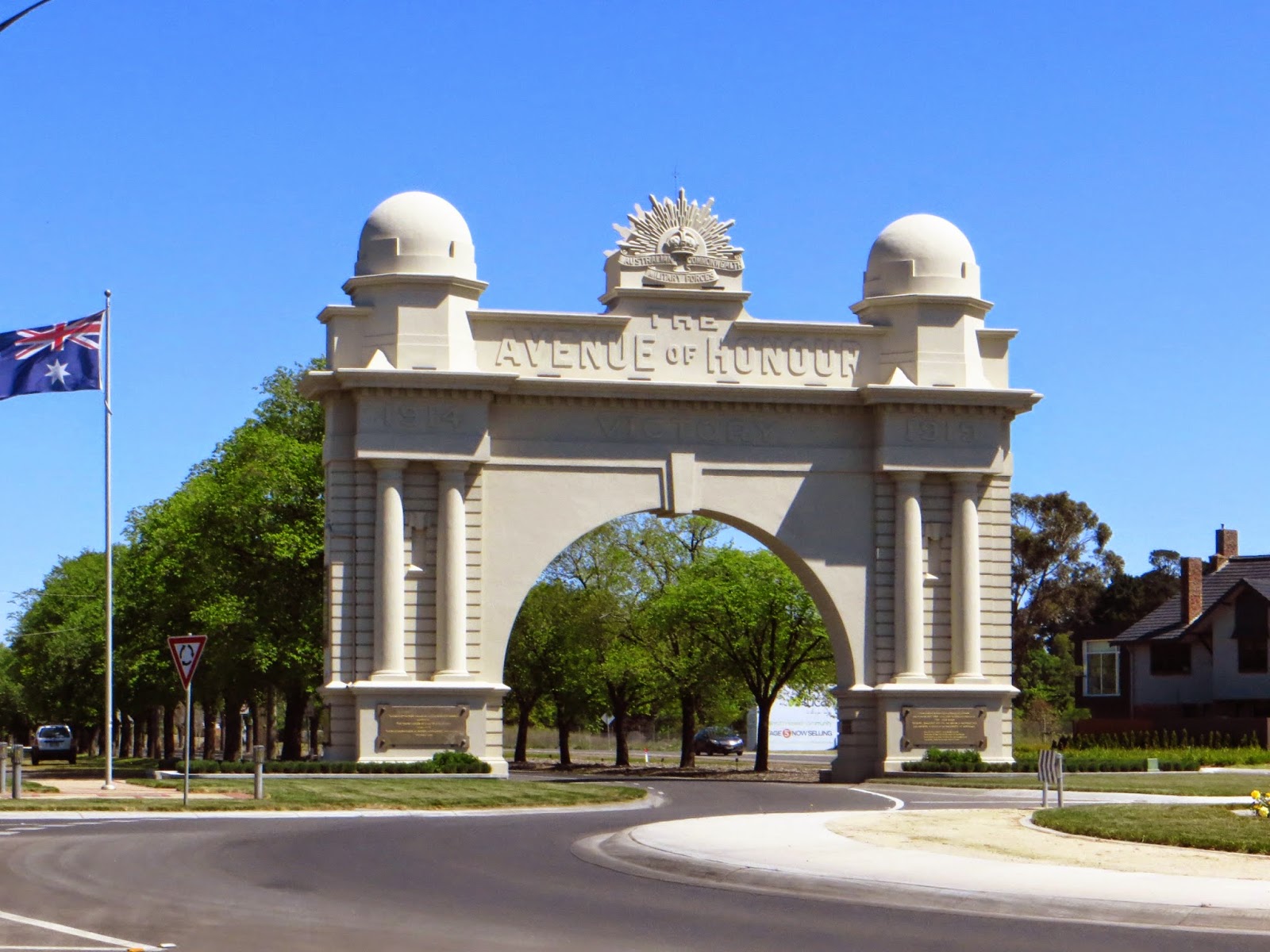
relative or platoon. Occasionally these avenues begin with triumphal arches, a
form which does not seem to have become widely popular due almost certainly to
its celebratory tone.
The Ballarat Arch of Victory and Avenue of Trees. Photo: Chris Betteridge
Conservation
issues
Conservation
work undertaken on war memorials reflects the broad approach taken in Great
Britain and generally involves careful cleaning, repointing to keep them
weather tight, re-gilding of incised lettering and protective waxing of bronze
honour rolls and figures.
It is the
guns shipped back from France and placed on top of many an Australian war
memorial that often prove to be the most problematic element for the memorial's
conservation due to the metal elements corroding and the wooden elements (e.g.
wheels) rotting. The numbers of the most fragile of them, however, the machine
guns, were dramatically reduced during the Second World War when they were
removed and refurbished for action.
With the passage of
time, war memorials have inevitably deteriorated, but it is a testament to the
resilience of the materials selected and the care with which they were built
that they remain in remarkably good condition.


.jpg)
.jpg)


 Posts
Posts


