Showing posts with label Australian War Memorial. Show all posts

Tuesday, July 7, 2015

Canterbury Museum Tales

I was delighted to be back in Christchurch last week for the first time since the 2011 earthquake, not least to find one of my favourite museums, the Canterbury Museum, virtually unscathed and bustling with visitors. Why one of my favourites? Well first up must be that it is unique, as far as I know, in having a delightfully obscure biblical text from the book of Job inscribed over its main entrance, "Lo these are parts of His ways but how little a portion is heard of Him".

Secondly, it has one of the world’s greatest Antarctic collections from the Heroic Era, in which pride of place must go to the vehicles. There is a wheel from the Arroll Johnston motor car that Shackleton took on his 1907-09 expedition in which he hoped to cruise to the Pole at a modest 25mph. There is the extraordinary plywood boxed motor tractor that was used on Shackleton’s second expedition, with skis at the front and a big paddle wheel at the back (remember that the tank had not yet been invented). This vehicle proved far more trouble than it was worth, and vastly less efficient than the humble Manchurian pony and huskie. And then there are the two vehicles that featured front of stage in the Trans Antarctic Expedition of 1957/8 - Vivian Fuchs’ lumbering great snowcat, and right beside it the canvas wrapped cab of one of Edmund Hillary’s’ converted Ferguson tractors. Each set off from opposite sides of the continent, and what an epic story it was as they fought their way to the South Pole. You will have to read the best book on the expedition to find out who (sort of) won or check out my blog from March 2015. 

Fuchs' Snowcat with Hillary's Ferguson tractor behind

Thirdly, the Museum has some very fine dioramas. The film Night at the Museum (and its endless successors) largely works through the scenes where its dioramas come alive. They were actually invented by Louis Daguerre (he of the Daguerreotype), and became in the early part of the 20th century a common museum technique for showing an historical event or a natural history scene. At their best they can impart a highly realistic view; the battle scenes in the Australian War Memorial’s World War One Galleries (see my blog from April 2015) providing a point of access for the visitors that few other mediums can provide. The fact they survive in so many museums is a testament to their interpretive power. At the Canterbury Museum they are principally used to depict pre-colonial Maori life and bird scenes. Both types in their own way are spectacular, notable because of the quality of the artwork.

One of the Canterbury Museum dioramas

So, when you are next in South Island, New Zealand do take time to visit the Museum – it’s a real treat.


Thursday, May 21, 2015

Conservation recognition and the Gilbert Doble story

I blogged a few weeks ago about the Marrickville Winged Victory conservation project and I am delighted to report that our work won a National Trust Heritage Award at last Wednesday’s Award presentations.

What is interesting about the project is that we still have not worked out how Gilbert Doble made his sculptures. A local Marrickville lad, he was clearly a bit of an oddball. At a time when any significant bronze foundry work had to be sent to England, he developed a home grown electro-deposition process that he perfected himself in his own studio in his back garden in Marrickville. Even after we have been intimately involved with the Winged Victory we still can’t quite work out how he did it.
The Winged Victory conservation team inspecting the sculpture 

The interesting thing is that, despite the failure of his Winged Victory sculpture (it only lasted 40 years before coming apart at the seams and needing to be brought down for safety reasons), his other public sculptures have lasted well. These include the Evans Memorial in Bathurst, notable according to the local guidebook for “its respectful depiction of an Aboriginal man crouched at Evans' knee - representing one of the Aboriginals who acted as a guide for Evans on his surveys.” 


As well as Winged Victory, Doble was also commissioned to undertake two other memorials, for Wellington and Pyrmont. At a time when war memorials were either a block of stone or had a soldier atop them, his approach was distinctive, avoiding the militaristic nature of such and concentrating on the mix of grief and motherly support to the fallen that his female figures depicted.


Pyrmont War Memorial

A fun side story of this project is that it has all been filmed as part of a 5 part documentary on the Australian War Memorial called 'The Memorial: Beyond the Anzac legend' put together by the Eye Works team for the History Channel. Neil Oliver (he of ‘Coast’ fame) fronted the cameras and kept us all entertained with his charming Scottish accent. 

The Winged Victory conservation team with Neil Oliver

And while we are on awards, I will just slip in that we also won a Highly Commended for our work on the Sydney Town Hall Air Raid Shelter sign. It was a good day for recognition of expert conservation practice.

Saturday, April 25, 2015

First World War memorials in Australia

Last year I was asked to write an article on First World War memorials in Australia for the UK National Trust’s Views Magazine. It was published in September 2014 and it seems apposite to retell in my blog today. 

By the time the Great War ground to a close in November 1918, 416,600 Australians had enlisted out of a population of 4 million, representing almost 40 per cent of men aged between 18 and 44. Australia's casualty rate was amongst the highest in the war at 65 per cent, including almost 59,000 dead.

The impact on a small and new nation (Australia had become a federation only in 1901) was profound. One of the most difficult issues to come to terms with was the remoteness of the battlefields. Whereas Britons could easily cross the Channel to visit the graves of their loved ones, the high cost of travel to visit Europe was beyond most Australians. As with Britain (but unlike the USA), the Australian Government made the decision not to repatriate any bodies from the war. The only exceptions were the body of an unknown Australian soldier and Major General Sir William Throsby Bridges, killed in Gallipoli, who was the country’s first major general and the first to receive a knighthood.

The war memorial scene in Australia
War memorials and their honour rolls therefore became critical points of remembrance for grieving relatives. They were not new to the country as Australians had died in relatively large numbers in the South African War in the 1890s and even in the New Zealand wars of the 1840s. But it was the sheer number of Great War memorials that transformed Australian townscapes.

Their form followed those created in Britain. They range from statues of soldiers to obelisks to arches and cenotaphs. Some of the designs were uniquely Australian, such as depicting Australian Diggers (soldiers), and almost without exception they used local stone except for imported carved figures in Carrara marble.

The city response
In the capital cities, Melbourne chose a vast Shrine of Remembrance with an inner shrine surrounded by an ambulatory where books in glass-topped cabinets record the names of the 114,000 men from Victoria who went to the war, a fresh page turned every day to this day. Sydney also chose to record all those who had gone to the war in its Anzac Memorial, not by name but by a gold star attached to the domed ceiling, some 120,000 in all. Beneath them, in the so-called Well of Contemplation, lies one of Australia's greatest bronze figures, a naked warrior carried on a shield supported by three women sculpted by Raynor Hoff, a Royal College of Art-educated Englishman of Dutch descent who had migrated to Australia in 1923. Considered somewhat shocking at the time of opening in 1934, it was heavily toned down from the original bronze concept entitled the Crucifixion of Civilisation, which had been denounced by clergyman for depicting tastelessly vivid horrors.

A mile from the Anzac Memorial, Sydney commissioned a stone cenotaph outside the City's General Post Office designed by Australia's most eminent sculptor of the day, the Royal Academician Sir Bertram Mackennal. Mackennal chose to place a bronze soldier and sailor either end of a large block of local granite. Brisbane initially commissioned Sir Edwin Lutyens to replicate the Whitehall Cenotaph with the addition of bronze servicemen but when this proved too costly they went for a Delphic-colonnaded temple designed by local architects.

 The Cenotaph, Sydney. Photo: Julian Bickersteth

The Anzac Memorial, Brisbane. Photo: Julian Bickersteth

The National Memorial in Canberra, known as the Australian War Memorial, was conceived and developed by an Oxford-educated Australian journalist, Charles Bean. Bean had reported from the Western Front and after the war ended was determined to do all he could to help Australians commemorate their loss. Principal amongst his means of doing this was the creation of the Australian War Memorial, which is actually a war museum centred on a Hall of Memory. This vast domed space is covered by the southern hemisphere's largest mosaic, designed by Australian artist Napier Waller. Waller was himself a war veteran; having lost his right arm on the Western Front but, undaunted he taught himself to draw again with his left hand.

Placement of guns
Bean also struck upon the idea of shipping back to Australia large quantities of captured ordnance. Again he saw the power in the tangible form of these weapons in bringing the battlefields a little closer to Australia. In all some 500 pieces of artillery, 400 mortars and 4,000 machine guns were shipped back and held in Melbourne for cities and local councils across Australia to apply for them. Due to over demand, a complicated system of ceding where each item of ordnance would end up was developed based on the number of men that had enlisted locally, the number of medals won and whether the particular gun had been captured by a local battalion. The allocation did not please everyone, with some councils complaining that they had only been awarded a machine gun when their war contribution surely justified at least a mortar.

Trees and arches
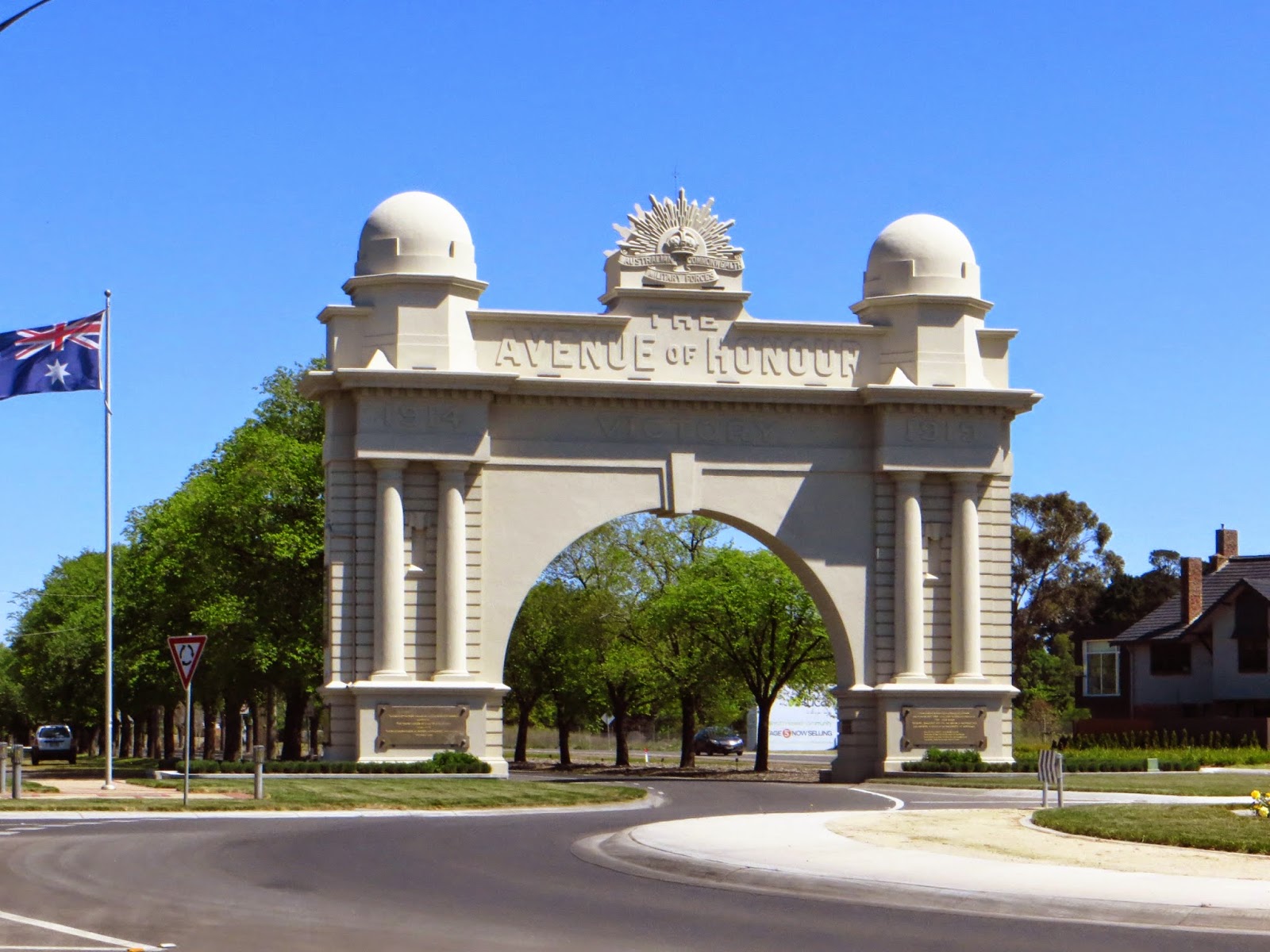
Avenues of trees are a particular feature of Australian war memorials. They came about as a reminder of the avenues of trees that lined northern French roads, beneath which the Australian Diggers would have marched. The avenues serve the useful purpose of allowing individual trees to be planted as a memorial to a slain relative or platoon. Occasionally these avenues begin with triumphal arches, a form which does not seem to have become widely popular due almost certainly to its celebratory tone.

The Ballarat Arch of Victory and Avenue of Trees. Photo: Chris Betteridge

Conservation issues
Conservation work undertaken on war memorials reflects the broad approach taken in Great Britain and generally involves careful cleaning, repointing to keep them weather tight, re-gilding of incised lettering and protective waxing of bronze honour rolls and figures.

It is the guns shipped back from France and placed on top of many an Australian war memorial that often prove to be the most problematic element for the memorial's conservation due to the metal elements corroding and the wooden elements (e.g. wheels) rotting. The numbers of the most fragile of them, however, the machine guns, were dramatically reduced during the Second World War when they were removed and refurbished for action.

With the passage of time, war memorials have inevitably deteriorated, but it is a testament to the resilience of the materials selected and the care with which they were built that they remain in remarkably good condition.

Monday, April 20, 2015

Winged Victory rises again

Seated in the sun outside Marrickville Town Hall in Sydney on Sunday morning to witness the unveiling of the Marrickville War Memorial I was thinking back 93 years to the same ceremony. The great difference of course was that the audience then included mothers, fathers, brothers and sisters and even children of the 458 local lads who had so recently given their lives. 

That said almost 100 years on it was a very moving experience to be part of, but, you may well ask, why was a war memorial being unveiled now.

The original Marrickville Soldiers’ Memorial was unveiled in 1919 by Sir Walter Davidson, Governor of NSW, before 15,000 people. The monument for the top of the Memorial was created by local artist and sculptor Gilbert Doble. Doble created a hollow Winged Victory sculpture, surrounded by a copper cast that created a dominant artwork within the tight constraints of the Memorial Fund’s budget. The instability of the resulting artwork became apparent as early as 1927. Within 40 years, the condition of the sculpture had deteriorated so badly that it had to be taken down in 1962. Despite being returned to the Memorial in 1988 following restoration work, the continued instability of the Winged Victory sculpture saw its removal a second time in 2008.


Gilbert Doble's original Winged Victory sculpture

Here at ICS we considered various options for restoring and reinstalling the statue but in July 2013, Marrickville Council voted to commission a new sculpture for the Memorial. Council also endorsed the transfer of ownership of Doble’s original Winged Victory to the Australian War Memorial in Canberra. We undertook the complicated restoration of the original and oversaw its transfer to Canberra, where the sculpture has now become the focal point of the Memorial’s new First World War Galleries, which opened in November 2014. 


Doble's Winged Victory sculpture 
now on display at the Australian War Memorial

Meanwhile Winged Victory, 2015 was commissioned from Melbourne's Meridian Sculpture with lead artists Peter Corlett and Darien Pullen in cast bronze. Reflecting and respecting the original Doble sculpture, there are subtle changes, most noticeably with the position of the sword changed from being raised in triumph to pointing down to touch the earth (‘earth to earth, ashes to ashes’ etc). Along the way it stopped the sword from being a lightning rod, which we had discovered was a significant cause of the damage that had been inflicted to the original. 


Winged Victory, 2015 by Peter Corlett and Darien Pullen

So Doble’s legacy lives on, both in original form at the Australian War Memorial and in reinterpreted form in its original location, and the citizens of Marrickville once again have a focal point to honour their local war heroes.

Thursday, August 21, 2014

World War One Museum Commemorations

Simon Jenkins made his name as a journalist, most recently with the Guardian, but in heritage circles we know him as a highly successful chairman of the English National Trust from 2008 until earlier this year, and also as a 21st century Pevsner with his great books on English architecture, most notably England's Thousand Best Churches.

So when Jenkins writes in the Guardian saying 1914: the Great War has become a nightly pornography of violence, it is worth reading. He goes onto say 'Britain's commemoration of the Great War has lost all sense of proportion. It has become a media theme park, an indigestible cross between Downton Abbey and a horror movie'.

Great stuff, and blogging this from the UK , there is certainly no escaping the commemorations (not to mention the 'stay calm and carry on' World War Two slogan which is in serious danger of being completely overused). So I was keen to see the highly acclaimed new World War One gallery at the Imperial War Museum in London.

Firstly, whatever Jenkins may think, there is no escaping the public interest. I had a four hour wait for timed entry into the exhibition, and the Museum was heaving with people. 

Secondly, it is a great exhibition on a subject I thought I knew a lot about, but came away knowing a great deal more. For instance, I didn't know that prior to the War the UK was producing nearly 80% of the world 's battleships, or that when Kitchener called for volunteers in 1915, he hoped for 100,000 and got 750,000, or that the Germans very nearly won the war in early 1918.

Thirdly, it is well designed with clear graphics and text, with content often repeated on other panels in slightly different ways, so one does not feel one has to read everything (impossible anyway given the crowds).

And finally, it has some really great objects. As often happens the mundane ones are the most powerful, a particularly striking one being an infantry officer's jacket with the left arm blown off. Explore the rest of that great museum if you make it there, the jacket having a parallel with a backpack that a soldier placed over a home made bomb in Afghanistan three years ago, when he hurled himself and said backpack on the bomb to save his comrades. Amazingly he escaped with bruising as his flack jacket was inside. He was awarded the Victoria Cross, but his back pack did not fare so well.

November 2014 sees the opening of the World War One galleries at the Australian War Memorial. From what I hear, they will rival those in London.

Tuesday, March 8, 2011

Remedial vs preventive conservation

One of the hats I wear is co-editor of the AICCM ( the professional body for Australian conservators) Newsletter. In the latest edition we sought responses from a number of senior Australian conservators on where they stood on the remedial versus preventive conservation debate. This was prompted by an interview in a recent edition of the Getty Conservation Institute’s own newsletter Conservation Perspectives in which my friend Stephen Rickerby of the Courtauld Institute in London was frank about where he stood on the issue:

I had greater faith in remedial intervention. That faith has been lost—for me and, I suspect, for many others in the conservation profession. There’s a global trend toward preventive conservation and site management and away from remedial intervention. While we all still practice remedial intervention, we now have doubts about its efficacy, and we place it in a context of wider conservation measures. That doesn’t necessarily mean that we believe those other measures are going to save paintings. I think there is a more realistic view of what we can and cannot do. The best we can do is to slow deterioration. We’ve hopefully lost a lot of our hubris in terms of what we think we can achieve.

The reality is of course that it is artificial to see the issue as remedial vs preventive, as each serves a different purpose. Remedial conservation is generally about active intervention - ‘doing’ if you like - whereas preventive conservation is about context - ensuring the conditions are appropriate for extending the life of the object as far as possible.

But in asking the question of others it has prompted me to question where I stand. Working in private conservation for most of my life has meant that there has been a lot more doing than preventive work – we get asked to ’fix’ things much more than to consult on their environment. And that is undoubtedly one of the attractions of private conservation. Too many of my public sector colleagues seem disillusioned with the profession, saying they spend much of their time in meetings or on condition reporting rather than working on things.

But as I get older, do I have less faith in our ability to intervene successfully? No, I believe that our interventions continue to be justified, the difference being that the experience of years mean I know more about the likely outcomes. What I can see is that I have less faith in modern materials, or to put it another way, err towards using traditional materials wherever possible as we can predict so much better how they are going to perform.

So what did other senior conservators have to say on the issue? Opinions varied ranging from David Hallam at the National Museum’s forthright comment that “Preventive conservation is a great ‘cop out’ for those who do not have the science basis or practical skill to carry out successful treatment” to Sarah Clayton at the Australian War Memorial questioning the success of some remedial conservation “Over the last 20 years I have seen too many interventive treatments that have not lasted the distance”, whilst David Thurrowgood at the National Gallery of Victoria stated that remedial skills are at the core of the conservator’s work “The skill of remedial intervention, the ability to sensitively and intelligently intervene in the care of an object, is central to what many conservators need to be able to undertake with confidence”.

In all we solicited almost a dozen responses from senior conservators. It confirmed that one size does not fit all, and that different approaches for different objects is vital. It highlighted to me that, like so much in life, experience and perspective counts for a great deal.

In conservation it gives us the confidence to do little or nothing where that really does appear to be the most effective option for long term preservation of an artwork or object. Barbara Applebaum’s seminal book on this issue ‘Conservation Treatment Methodology’ Elsevier 2007 is a must-read if you want to learn more.

Julian Bickersteth
Managing Director
internationalconservationservices

Monday, November 9, 2009

The efficiency dividend – or not

Working as we do in the private sector, there are various public sector anomalies that we just don’t get. One of these is the so called ‘Efficiency dividend’ that year in year out federal collecting institutions, e.g. the National Gallery, the Australian War Memorial, the National Library etc, seemed to get pinged with. Certainly from our perspective we can’t see any more efficiencies, and all that it appears to achieve is a reduction in staff and services.

Well, now this has been confirmed as told in a fascinating article published in Public Space; The Journal of Law and Social Justice (2009) Vol 3, and available on line.

The article details that the efficiency dividend was implemented by the Hawke labour government in 1986, as a short term budget cut designed to require agencies to look for efficiencies in their operations. But here we are in 2009 with the ‘dividend’ still being ‘paid’ to the government at an average of a budget cut of 1.25% per annum.

And of course as the efficiencies have long since been achieved, what it really means is a budget cut year in year out. The result is what we have been seeing, namely a diminution in staff and services, and this article spells out in graphic detail what these are. The information in it is drawn from a Parliamentary inquiry into the ongoing effects of the ongoing dividend.

Its’ effect crosses many parts of the institutions operations, from reducing and delaying digitisation work, cutting staff (to a level where the National Library states that in 3 years time the effect of the dividend will mean through resulting staff cuts ‘it will not be a viable institution’) , limiting pay increases and thus losing skilled staff, and curtailing touring exhibitions (the National Gallery has reduced theirs from 14 to 9 over the last few years).

It’s a depressing article, the one hope being that the Parliamentarians that heard the evidence at their inquiry are finally going to remove the dividend. Given that Rudd promised as part of his election platform that if elected he would cut an additional 2% from agency budgets to ensure efficiencies, I fear the future for collecting institutions is looking pretty bleak.

Thursday, February 19, 2009

Energy consumption in museums and galleries– what can we do about it?

Giving the IIC Forbes Lecture in 2004 Andreas Burmester, the director of the Doerner Institute in Munich, obliquely identified where he felt that current environmental standards for museums and galleries were going wrong. He had just finished acting as consultant to a new art gallery in Munich, the Museum Brandhorst, and had realised he had unwittingly been part of creating an unsustainable example of an environmentally controlled space.

Whilst the standard parameters he had dictated for climate and light levels( 22 degrees C, 55% RH, 50 lux for works on paper etc) had been achieved, the cost of maintaining them in a heavily glazed modern building, is massive. In addition, the technology involved, using computerised louvres and a vast HVAC plant, meant that the moment there was a powercut the entire system would close down and the building would essentially become an oven in summer and a freezer in winter. Contrast this with the existing 19th century art gallery, the Alte Pinakothek, which is not only extremely efficient to heat by hot air from the boilers in the cellars radiating up through the walls, but also thanks to its 6 ft thick walls, able to maintain internal conditions should there be a power cut for a significant time thanks to the thermal mass of the building.

But where to now, having created the international environmental standards that any self respecting gallery must comply with in order to be eligible for loans? The bad news is that there is unlikely to be any immediate loosening of these standards. However the possible good news is that the UK Council of Museum Directors have commissioned a review of the standards in the light of the energy requirements that result from them, and MAY end up recommending some relaxation of them.

Meanwhile, there is lots of good stuff going on at an individual institutional level to see how energy costs can be reduced, whilst maintaining acceptable conditions for storage and display of collections, the so called ‘preservation equation’. Both the National Museum of Australia and the Australian War Memorial have undertaken significant research into the capacity of various material types to cope with more relaxed environmental standards. And the State Library of Victoria experimented with turning its HVAC system in the book stacks off in October 2008 to gauge the effect on the environment and energy savings.

We’ve teamed up with leading environmental engineers Steensen Varming to help institutions look at ways in which they can potentially reduce their energy costs whilst still maintaining their collections in optimum conditions, and I expect to be writing more about this shortly.